Sunday, May 29, 2022

This Revenge Fantasy is no Bull


Nearly no critics did not like this grueling, Django Unchained style film. And what's not to like, unless you are even a little bit squeamish. Then you should probably avoid this Paul Andrew Williams entry. Because it starts violent and gory, and goes downhill from there.

The basic plot is almost too simple to lay out. The story of a brutal Mob Enforcer betrayed and seemingly murdered by the same mob, then miraculously returning to wreak vengeance is so simple, it is, itself a Trope. As many have observed, Neil Maskell is impossible to turn away from as the titular Bull (think DeNiro in Taxi Driver) , and David Hayman is almost better as the "ruthless Mob boss" from Central Casting.

If their great tradition of Mob Cinema is to be believed, the Brits are about the scariest Organized Criminals on the Planet - with the exception of Bratva. I soooo don't want to ever cross Bratva. Nope.

But Bull is not about the acting, or the direction or photography, all of which are first rate. It is about the lean, spare almost anorexic efficiency of how Williams tells the story. This efficiency is enhanced by a great narrative technique: the back-story of how Bull "dies" is told in flashbacks, chronologically, as the main story moves forward. Again, nothing particularly new here, but the technique is used so well it fits perfectly with the films overall manic purpose.

Clocking in at 88 minutes, Bull is a full speed freight train that starts fast and shifts into super high gear, never letting up until its curious Ending.

Yes, about the Ending. WTF? Is Bull actually a Demon from Hell (a la the excellent Nicholas Gage film Drive Angry)? Is this all a fever dream of a slowly dying Bull, who has been lit on fire and shot with a shotgun? We may never know. And that is probably very OK.

Wednesday, May 18, 2022

The Cinematic "prose" is Lean (Ha ha)


While I am a lifelong member of the David Lean Marching and Shouting Society, I had actually never heard of this minor jewel. Glad I checked it out.

In an earlier review I praised Lean's masterpiece, "Great Expectations" for remaining true to the spirit of the Dickens classic, while creating something new, as films so often do. "Madeleine" has more of a challenge, being based on a sensational True Crime story from the 19th Century.

Quick summary, daughter of a upper middle class family in 19th Century Glasgow has fallen in love with a smoldering French Lothario, while her by the books Christian Father desires that she matches with a some what milquetoast-y fellow who probably has 100 quid a year, or more. The story does involve murder, but I won't spoil it by saying much more.

Ann Todd, at the time the wife of David Lean is solid as the tortured daughter, and the cast as a whole is quite good. What Lean and screenwriters Stanley Haynes and Nicholas Phipps do so well is to spin the real-life story into something combining Henry James with Daphne Du Maurier, with a hint of Noir. This is 1950, mind you, for some the very height of the genre.

Like Stanley Kubrick, Lean's film-making is robust, meaty and always artistic. An example of this is a scene part way through the film where Madeleine and her Lothario are on a hillside above the Scottish resort town of Rohr (don't know the spelling) and hear music coming from the Pub down in the town. M starts dancing, and tries to get her man to join in.

Dancing, of course, post Hays code and pre- nudity in films is a metaphor for Sex, and as the camera deftly cuts back and forth between the townspeople dancing sweatily, and our two Lovers doing so more sedately. There is that classic cut where, it is assumed, they have had sex but they are completely dressed. They might as well be smoking cigarettes, the implication is so clear,

Much else about Madeleine is to be praised, including the Score, and of course Art Direction and Cinematography. I don't think there are a lot of Lean detractors, but they probably exist. If you like or love Lean, and haven't seen this one, Amazon has the excellent Criterion Collection version: Restored Film digitally transferred - presumably first for DVD. Streamed on a decent HD TV the film looks exquisite.

Friday, May 6, 2022

I don't usually compare the book to the movie, but...


I had seen this solid Carl Franklin thriller a few years ago. I recently read the book, and have fallen in love with Walter Mosley. I'm a big fan of Noir, Crime Thrillers, and trying to expand my reading of BIPOC authors.

Anyway, I did really like this, the second time. Only thing, I felt the book did do a better job of capturing the spirit of racisim that existed in post-war LA, especially from the point of view of the main character, Ezekiel "Easy" Rawlins. I will literally watch anything that has Denzel Washington in it, and here he is smooth, savvy self-assured as Mosley's GI Bill homeowner-turned-factory worker. What we don't know as that in this, the first Easy Rawlins mystery, Easy is learning to be what he will become in future books, a Private Detective. Or "Private Dick" as Jennifer Beals's Daphne Monet almost spits out when she first meets our hero.

The direction is assured, the screenplay sometimes a bit creaky, but largely true to Mosely's novel. Some reviewers have pointed out that the film takes a bit of a left turn in the Third Reel. I kept waiting for a crucial scene in a remote hideaway (won't spoil it, read the book) but that is morphed into a shootout in a Malibu house.

Cast here is top-notch. I would say, perhaps, Tom Sizemore as the sleazy gangster Albright may be best. He kind of inhabits the role. Beals is just OK as Daphne. I suppose the issue I had was with her hair and makeup - and costume. I kept thinking they dressed and made up Faye Dunaway way better in Chinatown. Not sure what to make of the minor characters, as they mostly seem a bit cardboard. Was expecting more from Don Cheadle as Mouse. Mouse is a crucial character in the book, albeit one who, although talked about a lot only appears in person in the second half. Cheadle seems to be thoroughly enjoying the role, but I don't think he ever nails it. Perhaps I was distracted by the Gold implants in his teeth.

Overall, taken separately from the book, "Devil" is a good film. Enjoyable, and breezy. A great slice of post-war LA. If you read the book, or plan to, perhaps watch the film first. Must my suggestion.

Sunday, April 17, 2022

Love in the (Magical) Afternoon


 I spend a lot of time reviewing older films, so I thought I would take on a (very) recent one. 

Anyone who has read my reviews knows that I tend to insert personal details into them. I suppose that is one way I connect with Film - on a personal level. The Harry Potter series of books and films has a special significance for me, as my daughters grew up reading the books, and seeing the films. I had the good fortune of attending a handful of special screenings of the films at the Warner Brothers lot with my daughter, Ali.

Regardless of how one feels about the "Wizarding World" is it is now so Corporately known, it is hard not to love the story both of how J.K Rowling struggled for years to get her books noticed (because she was a Female Fantasy writer?) and also how later Alan Horn of Warner Brothers promised her that he would shepherd the beloved books into legitimately good films. She didn't believe him, at first, but he came through. Mainly because he involved her in the production -- and she let go of the actual screenplay writing -- and early on, brought in the marvelous Steve Kloves to do the adapatation.

In some ways, in "Fantastic Beasts: The Secrets of Dumbledore" the band is back together. Minus Horn, who parlayed a highly successful run at WB to take perhaps the most coveted position in Hollywood, Head of Studio at Disney. But Rowling and Kloves re-unite to create a whole new story, that is not based on a book. They kind of "Game of Thrones" it, to some extent. Literally, and figuratively.

The world of this FB film is not the relatively happy world of the Harry Potter films. Oh, yes, they were tinged with darkness, but early on, and even through the end the kids -- grown into adults -- were what really drove the story. Here, no such luck. The eerily-named Grindelwald -- the name even sounds German -- is attempting to exert the Magical world equivalent of White Supremacy, by taking over the Worldwide Confederation of Magic with an aim toward wiping out the non- pure-blood "Muggles". 

How and why, and how it ends is for you to find out. I do not include Spoilers in my reviews. The conflict itself sets the stage for a multi-layered, surprisingly complex drama that is peppered with action set pieces. Jude Law plays a young-ish Aldus Dumbledore, excellent Danish actor Mads Mikkelson takes up the character of Grindelwald from Johnny Depp (that's a whole nother story) and the entire cast is brilliant. Veteran Wizarding World helmer David Yates turns in perhaps his best effort to date, and James Newton Howard's score pays just enough homage to John Williams without sounding obsequious.

 But, again, the accomplishment of FB III is how it juggles numerous very human story threads against the backdrop of a "the world is going to end" conflict. In that sense, another film where a small human drama plays out against a much larger backdrop, Casablanca, comes to mind. Dumbledore has been rumoured for years to possibly be Gay, or Bi. I won't say whether that is confirmed our denied here (I missed FB II, so don't scold me if it was revealed there), Eddie Redmayne is pining for his lost love. I would watch a film that was just about Eddie Redmayne pining for his lost love, he is so, so good. And numerous seemingly minor characters attain nearly Cosmic significance. Dan Fogler's Jacob Kowlaski is about the best "schmo" I can remember in film. Or, at least, for quite some time. And, in "Seabiscuit" fashion he plays a role in the Resolution that I, again, won't spoil.

Finally, Fantastic Beasts is really about the Beasts. And Magical they are. From the brilliant creations of the Qilins to the horrifying Beast which inhabits a Wizard prison in Germany, the SFX folks really went way, way beyond the call of duty. If you love the Wizarding World, or even if you don't you should spend some time here. You will not regret it.


Tuesday, April 5, 2022

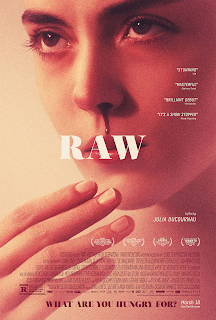
Cannibal Crush, its not


Well, that just happened. I agree with most Amazon reviewers (who agree with most critics) that Julia Ducournau's grisly paen to Vegetarianism is, well, its something. Highly original. Well-crafted. Not what I was expecting. In a word, mildly or very shocking.

Raw concerns a young French woman who is attending a Veterinary School as a "Rookie" -- a school where her sister is already a more experienced student. Following a very strange Hazing of the new students, the film takes several left turns about 1/3 of the way through, and it is not a spoiler to say that Cannibalism is involved. But, and here is perhaps Ducournau's brilliance, you hardly notice it is happening, and then it is just part of the fabric of the story. The very banality of the consuming of human flesh is what makes it so frightening.

Raw may not interrogate the boundaries of what is acceptable in Cinema, but it sure asks some interesting questions. No, post- House of 1,000 Corpses, post- Green Inferno, even post- Human Centipede, it is pretty hard to call anything genuinely shocking, or beyond the pale. I would say gut-wrenching is more the right description.

Garance Marillier plays Justine with just the right blend of wide-eyed naivete and clear-eyed commitment to the cause. The cause, here, being trying not to succumb to the strange illness that she has contracted from consuming, well, it would be a spoiler to say what.

It is possible to admire the film craftspersonship here, without buying in to the horror genre shock. Not easy, but possible. Definitely worth a watch if you love Cinema.

Thursday, March 24, 2022

Who are you?

Since I am on a current journey through my teenage years (see my last review of Licorice Pizza (https://medium.com/p/ab7a928e60de), why not re-visit this remarkable art-house gem from Aussie director Peter Weir? Starring the inimitable Richard Chamberlain who, to his credit, doesn't even try to fake an Aussie accent.

I have probably seen "The Last Wave" at least three times. Once, in 1977 when it was first released, again several years ago on a streaming platform, and last night on HBO Max. This kind of perspective can be valuable in assessing whether what one thought of a film when one first saw it still holds true. In the case of "The Last Wave", it really does.

The story line here concerns a Sydney Barrister who is asked to take on a "Legal Aid" (read, Pro Bono) murder case involving Aboriginals. A black man has died rather dramatically during a rain storm, and other black men are accused of committing Murder. Chamberlain rather deftly portrays the Barrister -- David Burton -- who has little experience in Criminal Law, and is more focused on raising his Bourgeois family in the Sydney suburbs than even the practice of law.

The plot and story are really a setup for the deeper artistic intent that Weir has going. This is not a story about an out-of-his-depths attorney trying to defend a black man accused of murder, it concerns nothing less than the terrible history of European Settlers in Australia, who destroyed traditional Aborigine culture and killed many people, and also the vast difference between white and Aboriginal views of religion, the Law, Ethics and even the Cosmos. Top that off with one of the best twist endings ever rendered in Celluloid and its no wonder the critics loved the film.

I first saw "The Last Wave" at the Monica Twin theater in Santa Monica, California. This very specific detail is fresh in my mind because I remember that, after watching out of the theater, my life had literally changed in the course of two hours. Weir's strange masterpiece, with its Cosmic storyline, deeply personal drama and dreamy camera work was one of a handful of films I saw growing up that made me love Cinema. George Roy Hill's multiple Oscar-winning "The Sting" was another.

Returning these many years later I was struck by how well it holds up. The narrative of a White (European) man trying to hold together a "center" which "cannot hold" (to paraphrase Yeats) is riveting, and in some ways horrifying. The more Burton tries to understand what has happened with these possibly Tribal Aboriginals, and take control of the situation in which he finds himself, the less able to do so he is. This kind of Cinematic entropy that brings to mind another great Fish out of Water tale from the same era, "The Wicker Man," where a British Police officer investigates the mysterious disappearance of a young girl on an Island that still practices a Pagan religion.

The rest, as they say, is History. Literally. But, is it White Man History (which follows a linear progression from the primitive to the modern) or Aboriginal History, which is timeless, and cyclic? The answer to that question might just save Burton's life. Or might not. The only way to find out is to watch this on your favorite Streaming platform: included "free" on HBO Max and AppleTV, and available for rent or purchase on most other platforms.

Wednesday, February 9, 2022

Its a Record Store! Its a Movie!


To say that Paul Thomas Anderson's marvelous coming-of-age tone poem, "Licorice Pizza" made me nostalgic is a huge understatement. Since I watched it a couple of weekends ago in a local art house theater here in my adopted home town of Tulsa, OK I have been thinking about my teenage years. A lot.

Well, maybe it has something to do with the fact I am about to turn sixty. Yikes.

Full disclosure. I grew up in almost exactly the region of Los Angeles in which the film is set. At almost exactly the same time. Watching "Licorice Pizza" was a bit like being teleported back in time, and what a time it was. LA of the 1970s was an amazing place, where the film industry was re-inventing itself, bands like Fleetwood Mac and Steely Dan were recording some of the greatest Album-Oriented-Rock ever committed to analog tape, and fashion. Well, fashion left something to be desired.

Anderson, as he has done in all of his films, positively nails this vibe. In "Boogie Nights" his visual style and precise exploration of character, and the human condition exploded onto the silver screen. And made Mark Wahlberg a star. That and his his prosthetic...well. Let's keep it PG here.

The film-maker has matured, and it shows in "Licorice Pizza". In "Boogie Nights" and even "Inherent Vice" he relied on the gimmick of the LA porn industry and the extraordinary story-making of Thomas Pynchon, respectively as platforms for his unique filmic 'voice'. "Licorice Pizza", by contrast, lays it all on the line, as the story is unknown and the two actors who play the main characters -- a la Wes Anderson's equally excellent "Moonrise Kingdom" -- were unknown prior to this film. So, it is all up to Anderson and his team of actors, DP, musical scorer, etc. to pull off what "Licorice Pizza" so remarkably pulls off.

Indie pop darling Alana Haim plays a twenty something lass with whom our main male character, a few years younger, becomes infatuated. The story of how that teenage angst-laden crush evolves to an almost adult Love is something to be seen. And heard. 

We pause for a message from our Radiohead-heads. Ha ha.

Anderson and Radiohead lead guitarist Jonny Greenwood have collaborated a couple times and "Licorice" is no exception. However, Anderson has an interesting approach to music in his films, in that he doesn't just have someone score the entire film, he uses a pastiche of original music and period songs -- hearing Bowie's wonderful "Life on Mars" really took me back, by the way -- so it is sometimes hard to tell where songs end and Greenwood begins. 

Again, for those who know, and love Radiohead, ha ha.

"Licorice", however, is all about the story, and the setting. The earnest push and pull of young love (not to be too cliched) is so beautifully rendered here, it is almost possible to miss the 1970s era San Fernando Valley sets that provide the background for said tale of love, loss, and love again. Anderson's camera follows our two young lovers from ranch style home to retail storefront to the iconic Hollywood Palladium in what feels like a single take. Not dissimilar to the single take opening of "Boogie Nights" with Rollergirl skating around the dance floor.

But I digress. "Licorice Pizza" is great film-making, and great acting. If Anderson doesn't finally win a Best Director Oscar, it will be a shame. But we know how good he is, so perhaps it doesn't matter,